From Terraces to All-Seater Grounds: A Short History of Stadium Crowds
Terraces to all-seater grounds changed how supporters gathered, moved and watched; learn what shaped the shift and how its legacy remains visible in stadiums.
The most common mistake in tracing the history of terraces to all-seater grounds is to treat it as a simple swap: standing was removed, seats were installed, and the crowd’s experience changed accordingly. That account misses what was lost and gained: not merely a posture, but a way of arranging people, movement and attention inside a stadium.
Terraces to all-seater grounds is a history with identifiable turning points, especially in Britain after the Hillsborough disaster in 1989 and the Taylor Report that followed. The shift did not happen everywhere at once, and its causes included building condition, crowd management and policy as well as the changing expectations supporters brought to a match.
Early grounds made room before they made seats
Many early sporting grounds began with little more than a playing area and its boundary. Spectators gathered along the edge, stood where they could, and watched from raised banks, walls or temporary structures. The familiar categories of terrace, stand and seating block emerged gradually.
As organised sport attracted larger audiences, clubs and ground owners shaped this informal space. Earth banks raised spectators above the pitch; timber structures offered shelter or a better view. A stand might appear beside an existing bank, leaving a ground assembled in layers rather than built to one comprehensive plan.
Materials and arrangements varied by site. Timber could be adapted or extended, while earth banks made use of the ground itself. Such structures also demanded upkeep and practical arrangements for getting spectators in and out.
Terraces made standing a designed form
A terrace was not simply level ground left to a crowd. Its rising rows gave people behind a better chance of seeing over those in front, while barriers and subdivisions helped organise space and movement. Concrete became a familiar material for terraces at many grounds, although development differed from club to club.
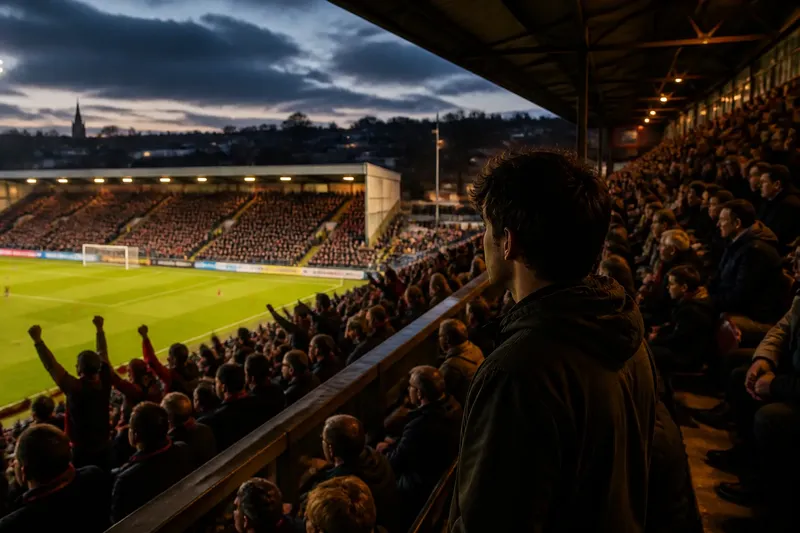
Standing accommodation let spectators shift position as the match unfolded. People arrived in groups, found room together and adjusted their view by moving along a row or up the slope. The crowd occupied a shared surface rather than a set of individually assigned places.
That freedom had limits. A terrace’s usefulness depended on its shape, access and management, and crowd pressure could make movement difficult. Open space was not automatically sociable or safe; its defining feature was the possibility of small adjustments within a common area.
Stands separated kinds of accommodation
As grounds expanded, many developed distinct areas for standing and sitting. Covered stands offered shelter and a fixed position, while open terraces remained a different form of accommodation. Where a spectator stood or sat often determined how they entered, gathered and watched.
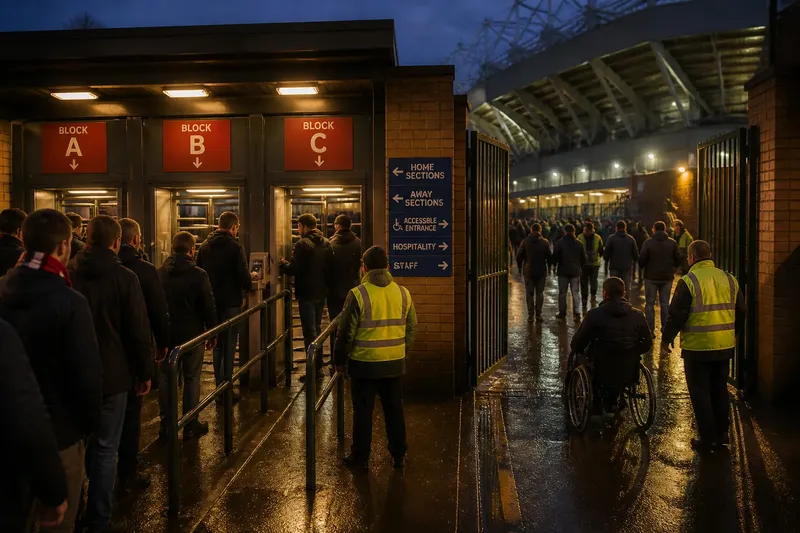
A roof, barrier, change in level or separate entrance could mark a boundary between groups. The stadium offered no single uniform experience: its architecture sorted spectators into spaces with different conditions and expectations.
Older grounds often accumulated repairs and additions. New sections rose beside existing ones, and constrained sites encouraged clubs to build upwards or use awkward corners. The resulting fabric recorded changing priorities without necessarily resolving the tensions between capacity, comfort and access.
Hillsborough changed how British crowd safety was judged
On 15 April 1989, 97 Liverpool supporters died as a result of the Hillsborough disaster during the FA Cup semi-final at Sheffield Wednesday’s ground. The Taylor Report, published in 1990, examined the disaster and made recommendations on stadium safety and spectator accommodation. Its final report called for all-seater accommodation at grounds in the top divisions of English football, with implementation taking place over time rather than through one simultaneous conversion.
The disaster did not make standing the sole explanation for danger. The official inquiry examined crowd management, access and the design and operation of the ground; safety depends on how these factors interact. The significance for terraces was that crowd movement, entry and control became central questions in policy and stadium planning.
Changes varied by ground and were shaped by the condition of existing structures, club decisions and regulation. Some stadiums were rebuilt or substantially altered; others adapted sections. The familiar terrace did not disappear everywhere in one act, and the form of accommodation that replaced it was not identical from site to site.
All-seater policy changed the unit of accommodation
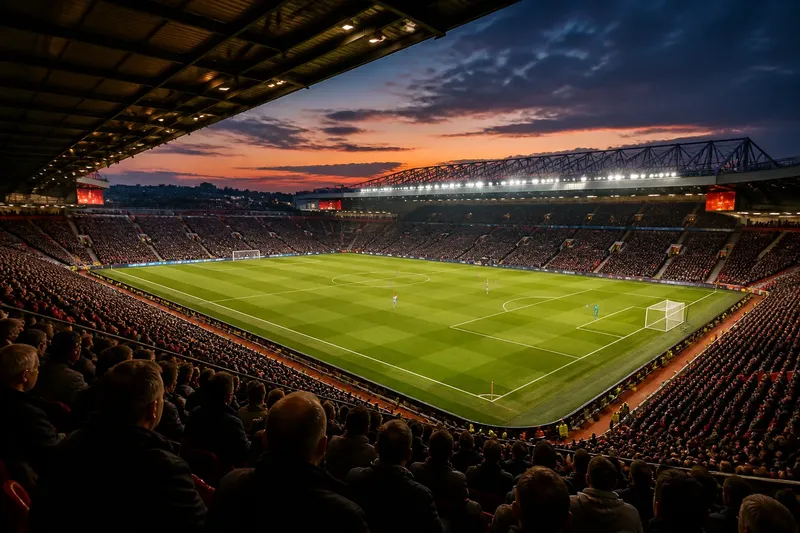
In an all-seater section, each spectator is allocated an individual place, usually a seat in a particular row. The crowd still gathers in large numbers, but its members occupy smaller, clearly bounded spaces. A ticket points to a defined position rather than an area in which a supporter finds room.
Seats brought a fixed position and made it easier to identify where a ticket-holder belonged. They also changed how people could respond to a match. Standing briefly might remain common in some settings, but a seated block was designed around individual places, not a continuous slope of standing room.
Conversion involved more than placing chairs on an old terrace. A ground had to accommodate aisles, circulation routes and access to rows. Say a club converts a standing bank into seats while keeping the same broad boundary beside the pitch: supporters who once chose a place in a shared area now follow their tickets to individual seats. The visible result is a crowd arranged in rows, with less freedom to move along the bank.
The change reached into supporter belonging
Terrace regulars often valued standing alongside familiar people, even when no specific place was reserved. A seat could make attendance more predictable, but friends might receive tickets in different parts of a stand. The physical change reached into the small arrangements through which people recognised their place in a ground.
Price and access also formed part of the debate. The cost and practical demands of seated accommodation differed from those of standing areas, and supporters worried that losing terraces could make attendance less accessible. Those concerns varied between clubs; they were part of the argument rather than a footnote to it.
There was no single emotional response. Some spectators welcomed a defined seat and a more orderly arrangement; others missed the openness of the terrace. For many, the change involved both a clearer place in the stadium and a diminished sense of occupying the match together.
Modern standing sections are not old terraces restored
Some grounds have introduced designated standing areas using seats or barriers designed to support spectators who stand during matches. These arrangements are sometimes called safe standing, but they are not simply a return to an unmodified terrace. They operate within contemporary stadium rules and use defined sections.
A standing rail provides support and marks a position; the surrounding area remains part of a managed modern venue. It may let people stand together, but it does not recreate the same open slope or informally chosen spot found on older terraces.
For supporters, this approach can restore some shared movement while retaining assigned or controlled space. It shows that stadium design continues to negotiate how crowds move and how that movement is accommodated.
What changed from terraces to all-seater grounds?
Did all-seater grounds end standing at matches?
No. Spectators may still stand in some seated areas, and designated standing sections exist at some grounds. The broader change was towards accommodation that defined individual places rather than continuous standing space.
Why did British grounds move towards all-seater accommodation?
Following the Hillsborough disaster, the Taylor Report recommended all-seater accommodation at top-division grounds in England. Safety concerns, policy requirements and differing ground conditions shaped how clubs acted on that recommendation.
Were terraces always less safe than seats?
Not as a simple rule. Safety depends on a venue’s condition and management, access and exit arrangements, and crowd movement. The history shows why dense standing space attracted scrutiny, not that posture alone determines safety.
Do modern standing sections recreate old terraces?
They can restore some shared standing, but usually use designated areas and supporting structures within a contemporary stadium. Their boundaries and management distinguish them from older, more open banks.
Stadium layouts still reveal how crowds are expected to gather
The history from terraces to all-seater grounds is a history of changing boundaries: between a crowd and a ticketed place, between open movement and managed circulation, and between accommodation built for density and accommodation built around individual positions. Each arrangement reflects practical concerns and assumptions about how spectators should occupy a ground.
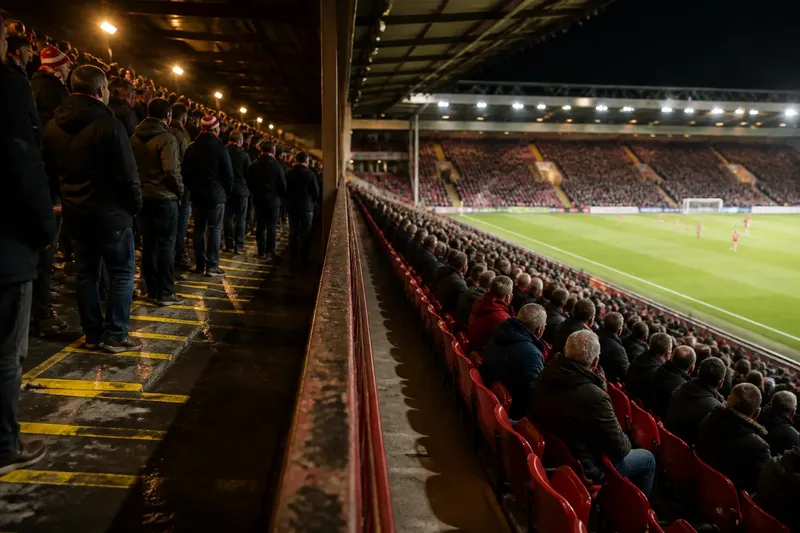
At a stadium, look for the transitions: seats above a standing section, a retained terrace edge, or a barrier dividing one area from another. These details show how the ground has made room for its crowd, and how much room it expects the crowd to make for itself.