Turnstile or Open Gate? Reading Stadium Entrances
Turnstile or open gate? Learn how stadium entrances direct arrivals, separate routes and shape the first moments of a matchday without confusing access with atmosphere.
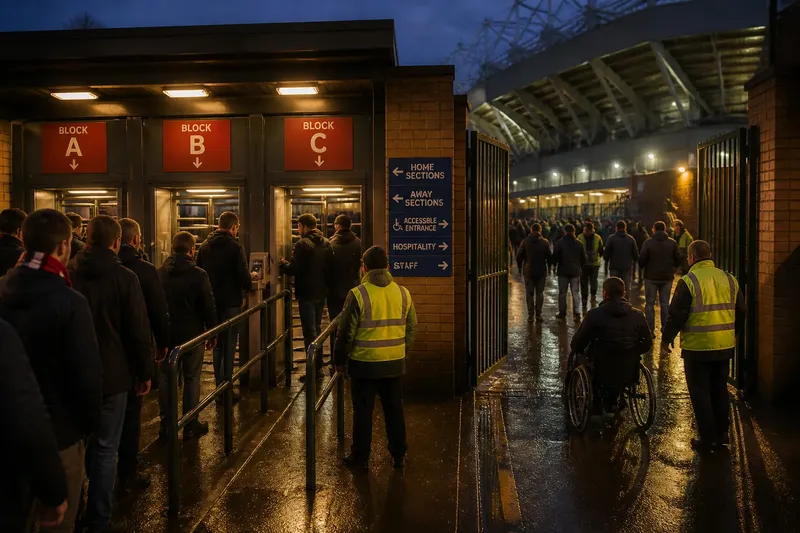
The common mistake in reading a stadium entrance is to treat every opening as a doorway with a queue in front of it. That misses the work each entrance is doing: sorting people, tickets and routes before the crowd reaches the ground proper. A turnstile or open gate can make that work visible, but neither tells the whole story on its own.
To understand how stadium entrances direct arrivals, begin outside the entrance line and follow the decisions a supporter has to make. Look at the approach, the point where routes divide, the device that admits people and the space beyond it. The useful question is not which arrangement is better, but what each one is meant to separate.
Start where the arrival routes begin
Approach a stadium entrance as part of a route rather than an isolated object. A bank of turnstiles may sit beside a broad concourse, while an open gate may receive a stream from a street, bridge or plaza. In either case, the path leading to the entrance determines whether people arrive in one line or several, and whether those lines can be directed without crossing.
Notice the signs before looking at the hardware. They may distinguish ticket blocks, home and away sections, accessible entry, staff access or hospitality routes. A turnstile bank can look uniform while serving separate destinations; a gate can look open while admitting only a particular group.
Follow the route with your eyes, not by stepping into a queue or obstructing stewards. The first clue is where people are being sent before they reach the barrier.
Read what a turnstile separates
A turnstile gives admission a distinct point. One person presents a ticket, passes through a controlled opening and emerges on the other side; the next person follows when the device is ready. That repeated rhythm can make a large arrival stream easier to divide into lanes and associate with particular sections.
Look for the relationship between each turnstile and the signs around it. Numbered or lettered bays may correspond to ticket areas, while a separate wide entrance may serve people who cannot use the standard passage. The turnstile itself does not explain the arrangement. Its role becomes legible through the labels, barriers and staff positions around it.
Turnstiles also mark a threshold in a way that an open passage does not. Before the mechanism, people wait and prepare tickets; beyond it, they are inside the controlled perimeter. That boundary can help prevent arrival routes from blending with movement already taking place inside the ground.
Look for a clear path after the turnstile. Admission is only orderly if people can move away from the device without meeting an opposing stream at once.
Read what an open gate separates
An open gate offers a broader passage and can receive movement that does not suit a narrow, repeated lane. It may serve accessible entry, groups arriving together, staff, equipment or a route that needs to remain flexible. Its openness is a physical feature, not evidence that entry is unrestricted.
Check how the passage is controlled. A gate may have a steward checking tickets by hand, a temporary barrier shaping the queue, or a separate channel that keeps one group apart from another. If the gate stands beside turnstiles, it often has a distinct purpose rather than being a spare version of the same entrance.
The wider opening can change the feel of arrival. People may enter in small groups rather than one by one, and the boundary can seem less mechanical. Yet that does not make the route less organised: staff, signs and barriers can do the separating that the turnstile performs through its fixed lanes.
Trace the routes after admission
Once people pass the entrance, watch where the routes lead. A set of turnstiles may discharge into a common outer concourse, then divide towards different stands. An open gate may connect directly to a separate approach or a level route that avoids steps and crowd crossings.
Notice whether the entrance keeps arriving supporters apart from people moving between areas. A route that joins a concourse at an awkward angle can create opposing flows, even if admission itself is orderly. Fences, railings and steward positions may guide people around that conflict; they are part of the entrance arrangement, not decoration.
Imagine a ground where ticket holders for one stand arrive along a narrow street, while supporters for another approach from a plaza. A turnstile bank at the first entrance could divide the street-side queue into labelled lanes, while an open gate at the plaza could serve a step-free route under steward supervision. The observable result would be two approaches feeding different parts of the perimeter, rather than one mixed queue attempting to sort itself at the last moment.
Track only what can be seen from a public route. The purpose is to understand the design, not to test a barrier or find an unofficial way through it.
Compare the arrangements without ranking them
Turnstiles are useful when admission needs a repeated, clearly bounded passage. Open gates are useful where a wider route or a different form of supervision is required. Neither arrangement is automatically faster, safer or more welcoming; those qualities depend on the approach, the organisation around it and the people arriving.
Compare entrances by asking what each one separates:
- Ticket groups: Do signs and lane positions direct people towards the right stand or block?
- Different kinds of access: Is there a distinct route for step-free entry or another specific need?
- Arrival directions: Are streams from separate streets kept apart until they reach suitable concourses?
- Inside and outside movement: Does the entrance prevent arrivals from crossing people already moving around the ground?
- People and equipment: Is there a wider passage for staff or items that should not use a standard turnstile lane?
These are questions about roles, not a scorecard. A single entrance can serve more than one purpose, and a gate that appears simple may depend on careful stewarding to work as intended.
What should you look for at a stadium entrance?
Why do stadiums use turnstiles?
Turnstiles create separate, controlled passageways that can be assigned to ticket groups or sections. Their visible lanes also make the point of admission easy to identify.
Why does a stadium have an open gate beside turnstiles?
The gate may serve a route or group that needs a wider passage, or admission supervised in a different way. Signs and staff positions are better clues to its purpose than its size alone.
Does an open gate mean anyone can enter?
No. An open gate can still be restricted by ticket checks, barriers or steward direction. Treat the instructions at the ground as authoritative rather than inferring access from the hardware.
How can entrances keep supporter routes apart?
Separate approaches, labelled lanes, barriers and distinct exits from the entry point can keep streams from merging too early. The arrangement is easiest to read by following each route from its approach to the concourse beyond admission.
Let the entrance explain its own purpose
Stadium entrances are clearest when you read them as a system: the approach directs people towards a particular opening, the opening controls admission, and the space beyond carries them to the next route. The turnstile or gate is only one part of that sequence.
Next time you consider how stadium entrances direct arrivals, follow the signs and the visible flow before drawing conclusions from the barrier. A narrow lane and a broad gate can both organise a crowd; what matters is the route each one is built to keep distinct.